mohammadalisalih.com
- HOME
- DOCUMENTS ABOUT SUDAN
- Recent Articles in Arabic
- MY MEMOIR BOOK PLAN
- ABOUT ME (ENGLISH)
- ABOUT ME (IN ARABIC)
- STORY OF MY LIFE
- SUDANESE OR AMERICAN? ARCHIVES
- QUICK QOMMENTS ARCHIVES
- 2009 QQs
- 2010 QQs
- MORE QQ 3
- OPINIONS IN U.S. NEWSPAPERS
- ARCHIVES, ALGERIA
- ARCHIVES, BAHRAIN
- ARCHIVES, EGYPT
- ARCHIVES, IRAN
- ARCHIVES, IRAQ
- ARCHIVES, ISRAEL
- ARCHIVES, JORDAN
- ARCHIVES, KUWAIT
- ARCHIVES, LEBANON
- ARCHIVES, LIBYA
- ARCHIVES, MOROCCO
- ARCHIVES, OMAN
- ARCHIVES, PALESTINE
- ARCHIVES, QATAR
- ARCHIVES, SAUDI ARABIA
- ARCHIVES, SUDAN
- ARCHIVES,SYRIA
- ARCHIVES, TUNISIA
- ARCHIVES, UAE
- ARCHIVES, USA
- ARCHIVES,YEMEN
- ARCHIVES, PHOTOS
- MY ISLAM ARCHIVES
- MY DIARY
- MY FAVORITES
- MY FAMILY
- (IN ARABIC) MY FAVORITES
- (IN ARABIC) BOOK REVIEWS
- (IN ARABIC)SUDANESE IN AMERICA
- (IN ARABIC) THE AMERICAN DREAM
- IN THEIR OWN WORDS
- (IN ARABIC) AMERICAN REPORTS ON SUDAN
- (IN ARABIC) MY WRITINGS IN AMERICAN PUBLICATIONS
- (IN ARABIC) ISLAM AND AMERICA
- DONATIONS (NON-PROFIT)
- CONTACT US
ABOUT ME (ENGLISH)
Translated from Arabic)
Talha Gibriel, Opinion, "Alahdath" Sudanese Daily Newspaper, 3 October 2009.
My years in America (18): Muhammad Ali Salih, and Karima Train Newspapers
Now, I will write about my impressions about the Sudanese in America, but with a fundamental reservation, which is that by the Sudanese I mean those I have met in the greater Washington area, which includes Washington DC and the states of Virginia and Maryland, as well as some Sudanese in both New York and Pennsylvania.
There were, of course, Sudanese scattered in all the states, and I met some of them, but I do not claim that I have known the details of their societies and the circumstances in which they lived.
And I think it is chivalrous that my entry point to talk about Sudanese Americans, is to start with the colleague and friend with whom I shared one office throughout my years in America.
But, I got to know this virtuous man, in fact, many years before I met him. The truth is that predestination played its role in weaving coincidences very efficiently.
How is that?
I will tell you.
In those days that are now receding into the shadows of memory, there were two trains arriving every week at Karima from Khartoum. In theory, the train was supposed to leave Khartoum on Sunday, to arrive in Karima on Monday, or on Wednesday to arrive on Thursday.
What was important to us about Karima's train when it arrived at the station, and we were students in Karima Industrial School was one thing: the newspapers it brought from Khartoum by passengers.
After the tired travelers landed with their iron bags, clothes, and faces that had accumulated layers of dust, we would go to the train cars to search for the newspapers that the travelers had left inside the cabins.
At that time, I liked the writings of a young reporter who specialized in international issues, and his style was based on short sentences with copious information.
I still remember a topic he wrote on "the differences between the Baath parties in Iraq and Syria." In fact, my interest in what was stated in that report was due to the atmosphere of that period in the Meroe region …
Now I go back to those newspapers that we used to collect torn and dirty, but we were reading them very avidly, and we benefited a lot from them. The reporter whose reports I was very much interest in was none other than my dear colleague, "Muhammad Ali Muhammad Salih," precisely the one with whom I would work in one office at the National Press Building in Washington, DC.
That was the office of “Asharq Al-Awsat,” number 1199. And the colleague "Muhammad Ali Salih" as he had shortened his name.
That was in 2005.
I remembered reading his reports about 40 years earlier, never thinking I would meet him in Washington, DC, and working in one office.
Unexpectedly, I found him one of those people who preferred a quiet life, far away from noises, crowds and troubles.
Muhammad Ali Salih comes from the village of Wadihaj in the Arqo region, and his father is Muhammad Salih Wad Idris from al-Kababish Arab tribe.
Muhammad Ali Salhh graduated from the Faculty of Arts at the University of Khartoum in 1967. Made his first visit to America in 1973 with the encouragement of his boss Muhammad Al-Hassan Ahmed, who continued to be fond of him for the many years that followed.
Salih obtained a master's degree in journalism from Indiana University. Willfully and faithfully returned to Sudan in 1976.
Before being sent to America, he was, before and after finishing the University of Khartoum, a part-time reporter, then the Foreign Editor at “Al-Sahafa” daily newspaper in Khartoum. from 1964 to 1978.
Actually, before the University of Khartoum, he started writing for “Al-Sahafa” in 1962 when he was still a student at Wadi Seidna Secondary School.
So, in 1976, he returned to Sudan from the US with master degree in journalism. And after two years in Sudan, he moved to Saudi Arabia to work with “Al-Madina” Arabic daily newspaper.
A well-intentioned and hard-working man, he was quickly rewarded, when “Al-Madina,” in 1980, send him back to America, to be its correspondent in Washington.
In 1985, he moved to Saudi Research and Marketing Group’s office in Washington. Joined “Al Majalla" in 1985, and then "Al Sharq Al Awsat" newspaper in 2003.
I first met him when I moved to Washington as Bureau Chief of “Asahrq Alawsat.”
And remembered Karima’s train, the old newspapers, and his fascinating reports.
So, this is Muhammad Ali Muhammad Salih, I said to myself
The most important thing that distinguishes Muhammad Ali Salih is that he is a serious, resolute and meticulous man. Shy personality. Reticent in his behavior. Generous.
He has a rare intellectual vitality. Jump into writing without preconceptions or rigid positions.
Steel nerves. But he is very gentle in humanitarian situations, to the extent that he does not hold back his tears when a human condition shakes him.
It appears to have sediments of rural origins.
One of the best Sudanese who knows the secrets of the political reality in America.
He is distinguished by a great deal of integrity and seriousness
Good-natured, cheerful and funny in a way.
He has a disturbing tendency to tell the truth.
In his eyes a bird's euphoria.
I found him a man of impressive congenital toughness.
Has the efficiency of dealing with emergencies and surprises, filling gaps and gaps, and absorbing tremors and shocks.
Muhammad Ali Saleh preferred to start his work early in the morning, so he was the first to come to “Asharq Alawsat" office. And he does not go out until he has accomplished what is required of him.
He kept listening to Radio Hana Omdurman while he was busy with his daily work. I was astonished by this inimitable ability to listen and write at the same time. He speaks English with a clear American accent, which is normal after all the years he stayed in the American home, but I always felt that he had a sweeping nostalgia for Sudan.
When I got to the office in the morning, to avoid disturbing his apparent inclination to calm, I would greet him with a brief morning greeting.
Good morning Muhammad
And he replies with a sentence that he does not change: "Hi Talha."
When he finishes his job, he would pass by my desk and say one sentence he didn’t change: "Bye Talha."
On the wooden dividers that separate his office from the rest of the offices of colleagues and colleagues, he hangs some newspaper clippings, without a link between them. And he alone knew why to fix the scraps to those wooden dividers.
I have never been involved in his work. He chose the topics he wanted to write about. And if it happened, which were rare cases, when I asked him to write a specific report, his only question was "How many words?"
He remained a work-loving man. Even when he went on vacation, he would send the newspaper reports. He loved writing about history, so I respected his constant desire to spend the long hours searching and rummaging through the documents of the US National Archives in Washington.
He always wished that "the Sudanese word would be united", so when we set out to establish the "Sudanese Journalists Union in America", the founding meetings were held in his home, although he consistently refused to become a member of the executive committee of that union.
When I wanted to get to know the Sudanese community in Washington, Muhammad Ali Salih was always there for me.
-----------------------------------------------------------------------------
April 24, 2011
Against Islamophobia: The One-Man Jihad
By Marta Steele
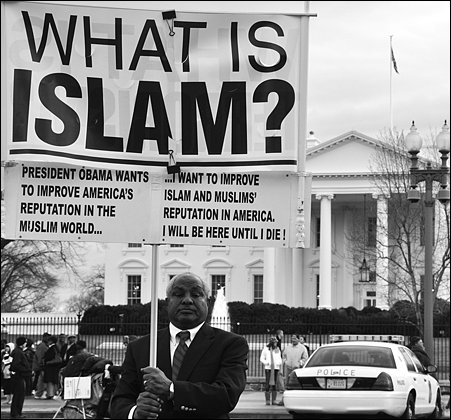
Most weekends, in front of the White House, you will come upon a one-man jihad, a man in a dark suit fighting against Islamophobia.
He carries a large banner with messages on either side. One side reads, "What is Terrorism?" and the other side, "What is Islam?" In small print on both sides, the banner adds: "31 Years Washington Journalist. Don't Trust Politicians. Appeal to People's Conscious [sic]. Will be here until I die!"
He would like to raise enough money at his website to be able to vigil full-time for the rest of his life.
This is Mohammad Ali Salih, who immigrated here from northern Sudan in 1980 and has since then worked as a freelance journalist for American and Arab newspapers. His op-eds have been published repeatedly in the New York Times and the Washington Post, among other prominent U.S. newspapers. He has been married for 35 years to a white conservative Christian Republican, whom he met in this country. Together they have borne three children and reside in Burke , Virginia .
He had wanted his children to have not one race but two. Now he realizes that race doesn't matter and that mixed race doesn't matter, but that "the new 'post-race' thinking could be equivalent to 'no race.' His son refers to himself not as biracial but "post-racial."
"A country without racial divisions. What a concept" ended this recent USA Today autobiographical column. (All of his op-eds are in one way or another autobiographical.)
He has immersed himself and his children in other religions of this country and the world, including Christianity, Judaism, Hinduism, and Buddhism. He has written of spending a day of Ramadan at a Catholic monastery and of attending Orthodox Jewish Rosh Hashanah and Yom Kippur services as well as a Passover Seder. He is teaching his children to be open-minded. This writer got to know him at DCIPI (DC Interfaith Peace Initiative) meetings. a group that discusses and activates interfaith outreach ideas and events--one of many in this enlightened and cosmopolitan area.
*****
Mohammad Ali Salih's first memory "has become a symbol of my life-long struggle between Islam and the West":
"The eldest of 15 brothers and sisters, I was probably three-years old, with my father and mother in a ten-by-ten ft. mud room that had a ceiling of tree branches and leaves, like most houses in my poor Sudanese village, on the Nile River, south of the borders with Egypt.
"It was evening and the room became dark and my mother lightened a kerosene lamp, and my father struggled to start a portable kerosene pressurized stove. Those were the first Western technologies my father bought after he married my mother and they were the latest in a village where most people use candles for light and wood for cooking.
"That evening, while my mother was making "shai samooti," (heated milk with tea), our evening meal with home-made biscuit or dried bread, my father spread on the floor a colorful mat, faced Mecca and started 'Magrib' (sunset) prayer. He stood up, loudly recited verses from the Koran, bent forward, sat down, touched the floor with his forehead, stood up and repeated those movements few more times.
"I can still visualize the singing sound of the Qu'ran verses mixed with the sound of the pressurized-stove's blue flames, while I was waiting for supper. . . ."
In this journalist's words, again:
"My village looks like one of those Afghan villages shown on TV, with mud houses, donkey carts and men in flowing garments. Sheep and goats are kept inside homes; dogs wander the streets; women cover their bodies and hair, but not their faces."
*****
Further on his lone crusade: "Since Sept. 11, 2001, I have felt sadness, anger and frustration because of what I had come to believe were President George W. Bush's subtle wars on Muslims. Because I had no outlet for this opinion in U.S. newspapers, I launched my one-man campaign."
Mohammed's weekend vigils in front of the white House began in 2008, the last days of the Bush administration, in his despair over the Islamophobia and Bush's "War on Terrorism" that has since 9/11 pervaded this country. He also began to write op-eds for U.S. newspapers.
"Believing that my conduct was part of my message, I dressed in dark suits, refused to engage in discussions, and only briefly and quietly answered questions."
*****
When Obama was elected in 2008, Mohammad ceased his vigil, believing that a more enlightened leader than Bush was now in the White House. However, "I believed in his campaign promises to end Bush's militaristic and antagonistic foreign policies, to change the tense political atmosphere in Washington , and to soothe the American
people and give them some hope. When Obama went to Cairo last summer, he extended a peaceful hand to the Muslim world and called on Israel to stop its expansionist policies. He was even reported to have ordered government officials not to use the term 'war on terrorism.'
"But after watching Obama in the White House for [ . . . ], I had come to believe that he is a typical politician who makes promises in order to be elected and, once elected, starts planning to be reelected."
On January 16, 2010, in a Washington Post op-ed, Mohammad announced that he was resuming his jihad in front of the White House.
"I am not faithful enough to sacrifice with my money (I barely make ends meet), with my family (I want them to be near me), or my life (I don't think I have enough left). So this weekend I will resume my jihad in front of the White House--peacefully, silently and alone.
*****
Mohammad is first a Muslim, then an Arab, then an American--he is a citizen of this country. He refers to his identity in terms of four minorities: "Muslim, Arab, African, and 'foreigner'."
As to his outspoken priorities, he writes: 1) "My relation to God is the core of my identity. It supersedes my relations to countries and peoples and is separate from my citizenship. His religiosity has come and gone throughout his life; most lately, he has rediscovered Islam and is once again studying Koran--this time as an adult."
2) "I am Arab because Arabic is my native tongue, the core of my culture. I think, talk, write (and dream) mostly in Arabic."
3) "My love for America started long before I came here, by reading, writing, thinking, and dreaming about America--in Arabic. My religion was never an obstacle and actually was an incentive. I dreamed of worshiping God in America the way I wanted, with no restrictions from oppressive Islamic governments, medieval sharia scholars, and the people around me.
"But, like love that develops into marriage, I had to come to America and become a citizen to be a full American. And, [pledging allegiance is] like pledging to a marriage: 'I pledge allegiance to the flag of the United States of America , . . . one nation under God.' That's when I said to myself: 'God is paramount here, too.'"
"Previous Pew polls showed that 42 percent of Christians identify with their religion before their country. . . . That doesn't make them less American."
Rereading the entire Qu'ran as an adult, Mohammad has discovered much that he said previously eluded him:
"The hundreds of warnings, in a tough language, to those who stray from the 'Straight Path,' . . . ? The rest of the Koran, like all other major religions, calls for love, peace and justice, but I have found that accompanied by warnings, threads and repeated mentioning of 'Hell's Fire.' I have found God both merciful and angry, but, I am afraid, I feel He is more angry, which adds to my fear of Him.?[Also striking to Mohammed are] 'sensational' verses about cutting hands, stoning sinners and marrying four wives, [which occur in] very few . . . numbers. All the verses about that and the rest of the Sharia (Islamic laws) [comprise] about 1 percent of the whole Qu'ran. [The rest] is God talking about His powers, books, angels, prophets, and about right and wrong and heaven and hell.?[Also striking are] the very many times God refers to Himself; in almost every verse and, sometimes, more than once in a verse. There are about 7,000 'ayat' (verses) in the Koran, divided into 114 'suras' (chapters). There are probably 7,000 mentions of, or references to, God.
And, on the subject of religious values, in another of his op-eds he recalls a conversation among some of the men in the village he once called home. They were railing against the wickedness of Westerners when one old man chimed in, "Why speak of punishing these people instead of helping them?"
*****
He wrote about a cover story that appeared in Time magazine August 30, 2010, on Islamophobia: It mentioned that more than half of Americans had a negative attitude toward Islam and Muslims and that almost half of them said that Muslims believed in ideas contrary to basic American ideals of freedom and justice. The magazine said Islamophobia influenced domestic and foreign U.S. policies.
Further, according to Time, in 2003, "a survey by Pew Research Center found that the percentage of those holding a "favorable view" of the United States was as low as 1 percent in Jordan , 13 percent in Pakistan and 15 percent in Turkey ."
"However, those who admired U.S. technological achievements were 59 percent in Jordan and 42 percent in Pakistan . Opinion of U.S. popular culture was mixed, but more positive than one might expect. In Lebanon , 65 percent said they liked American music, movies and television, and in African countries with significant Muslim populations, such as Senegal and Nigeria , majorities said they liked American popular culture, although majorities in Jordan and Egypt said the opposite."
He marvels at Hillary Clinton's request to Congress for more funding for the State Department to be spent on improving the U.S.'s image in the world, as if money were the answer, as if minds could be changed with the right p.r. ,"as if the U.S. reputation were based on how much we spend."
He is bitterly disappointed that the U.S. supports the partitioning of his native country, wondering where the spirit of Lincoln has fled, a spirit that fought to the death to keep this country whole.
Ambiguities pervade all of our lives, as do jihads--struggles--of every description. Mohammed's thinking about one aspect of the Muslim-West jihad, the struggle between Palestine and Israel, has evolved:
"1960's and 1970's (in Sudan ): supported Egypt 's Nasser call for the expulsion of the Jews."
"1980's, 1990's and 2000's (in U.S.A. ): supported the two-state solution."
"2010 and 2011: support one Palestine/Israel because I have come to believe that the Israelis, with the help of the U.S. , will expand the settlements and will not accept a viable and sovereign Palestinian state. Many countries might recognize th current Palestinian 'state,' but, it is not a state. Within a Jewish/Palestinian state, the Palestinians can expand in numbers and call for equal rights."
*****
Mohammad has written for numerous Arab newspapers and magazines, including three privately owned but under Saudi government control.
From the 2000s to the present, he has been a Washington correspondent for one of these, Asharq Alwasat ("The Middle East"), an Arabic international daily published out of London . Twenty of his articles, on a wide array of subjects, are online athttp://www.asharq-e.com/. Those are the only ones accessible in English. Type his name into the search space to pull up articles he has written.
For much, much more on this fascinating journalist, whose handle is "MellowMuslim" on Twitter, visit his website at
http://www.mohammadalisalih.com/.
Photos courtesy of Mohammad Ali Salih.